
From competition to coordination: engagement spaces in practice
How can we deal with scarcity without competing with one another? The concept of “engagement spaces” sounds abstract, but two pilot projects demonstrate how travelers, residents, and businesses are already learning to coordinate. From a street that saves together for road safety to an urban experiment with mobility credits. Read here how engagement spaces are coming to life step by step.
Anyone who has ever been stuck in traffic, couldn't find a seat on the train, or stood in line for a public transport bicycle knows: our mobility system is full of scarcity, and it is only increasing. In recent decades, the focus has primarily been on increasing supply by building more infrastructure. However, because lack of space, nitrogen issues, and climate goals mean we cannot keep building indefinitely, the question is increasingly: how do we distribute what we do have in a smart, fair, and collective way?
This requires innovative concepts. One of these is the idea of having travelers coordinate their movements with one another. Imagine if travelers had insight into the effect of their travel behavior on the ability of others to travel. Better yet: imagine if they were also actively encouraged to trade their place with someone else and choose a more sustainable, safer, or less scarce alternative instead. This is the idea behind “engagement spaces”: physical or digital spaces where people arrive at the best choices together through fixed rules of play.
Interaction is facilitated within these engagement spaces. Travelers then understand the consequences of their choices for others and are encouraged to accommodate one another. That probably sounds abstract and idealistic, but upon closer inspection, it is already being applied in practice. Below are two examples.
Example 1: SafetySafe
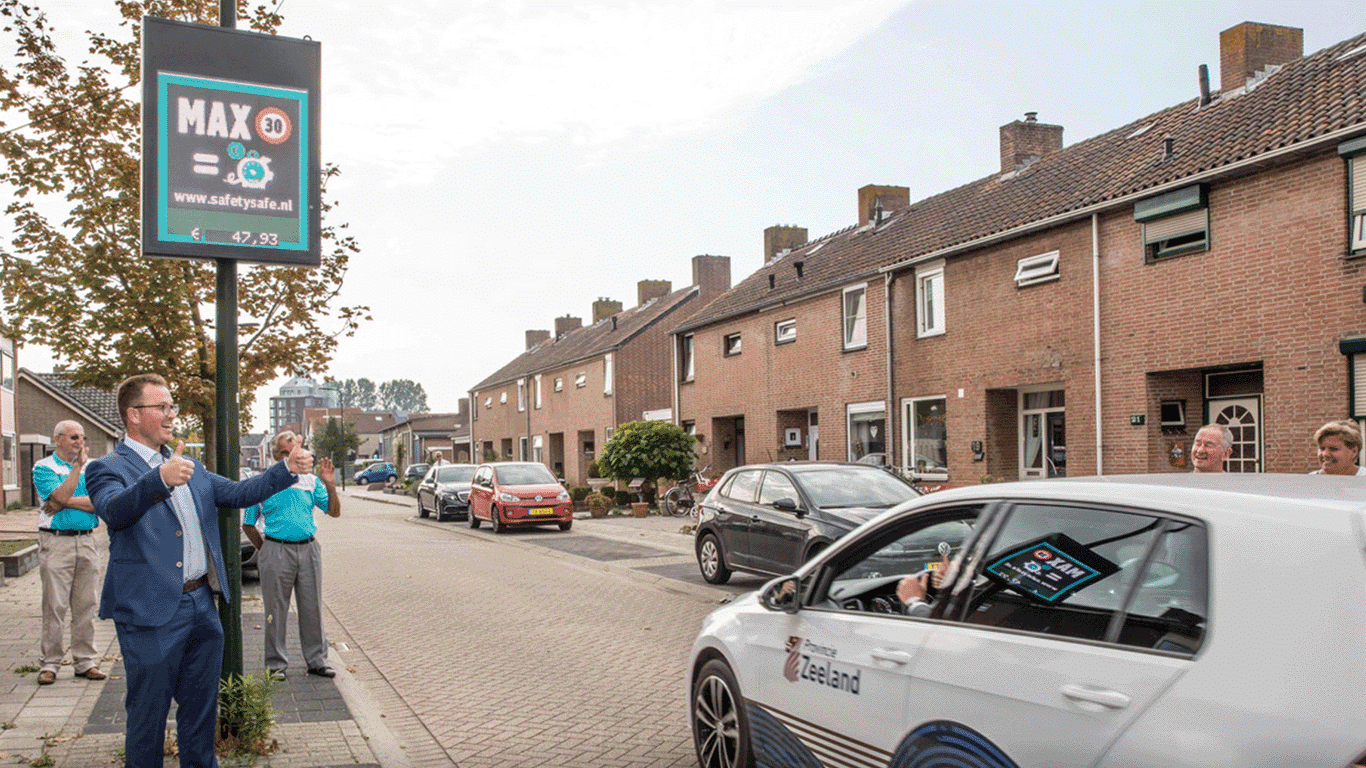
Anyone who has ever driven through a residential area knows the sign: a smiley face that turns green and smiles or turns red and looks angry, depending on your speed. But what if every green smiley, in addition to safety, also yielded something extra for the neighborhood you are driving through?
That is the principle of the SafetySafe, an innovative approach to road safety in which good behavior is rewarded with a donation to a collective savings goal. Not punishing the individual offender, but rewarding the collective good behavior of the neighborhood.

The power of saving together
In the neighborhood where the SafetySafe is placed, a residents' evening takes place. It starts with residents wanting to work together for a more pleasant neighborhood. In addition to the desire for more road-safe behavior, other ideas are put on the table: do we want a new playground, a safer crossing, or perhaps more greenery in the street?
The best ideas go into a digital voting round, and the entire neighborhood is allowed to vote. The municipality then adopts this savings goal.
Then the real work follows: the screen is installed and the savings button is activated. Every car that adheres to the speed limit makes the savings balance grow. And it works! One proud resident put it as follows:
“The campaign really helped. Previously, 85% of all passing cars in this street drove too fast. During the campaign, we saw that drop to 29%.”
Motorists start driving slower and the neighborhood's savings goal is realized. But the real effect is social. People feel more involved in their neighborhood because they are working together on something that belongs to them. Neighbors seek each other out more and the mutual bond is strengthened.
SafetySafe as an engagement space
The SafetySafe essentially creates an engagement space: it ensures that a group of people makes agreements together to achieve a better outcome for everyone. By coordinating with one another and rewarding socially desirable behavior, an outcome is created that is better for everyone.
And of course, when the screen has disappeared, there is a risk for some that old behavior will creep back in. Sometimes a new physical savings goal in the street is targeted to repeat the process. Sometimes infrastructural adjustments are also made to the street. The realized savings goal then forms a permanent reminder of this collective success. In this way, this project ensures that the we feeling returns, in a mobility system that otherwise too often is primarily about me.
Example 2: Mobility credits
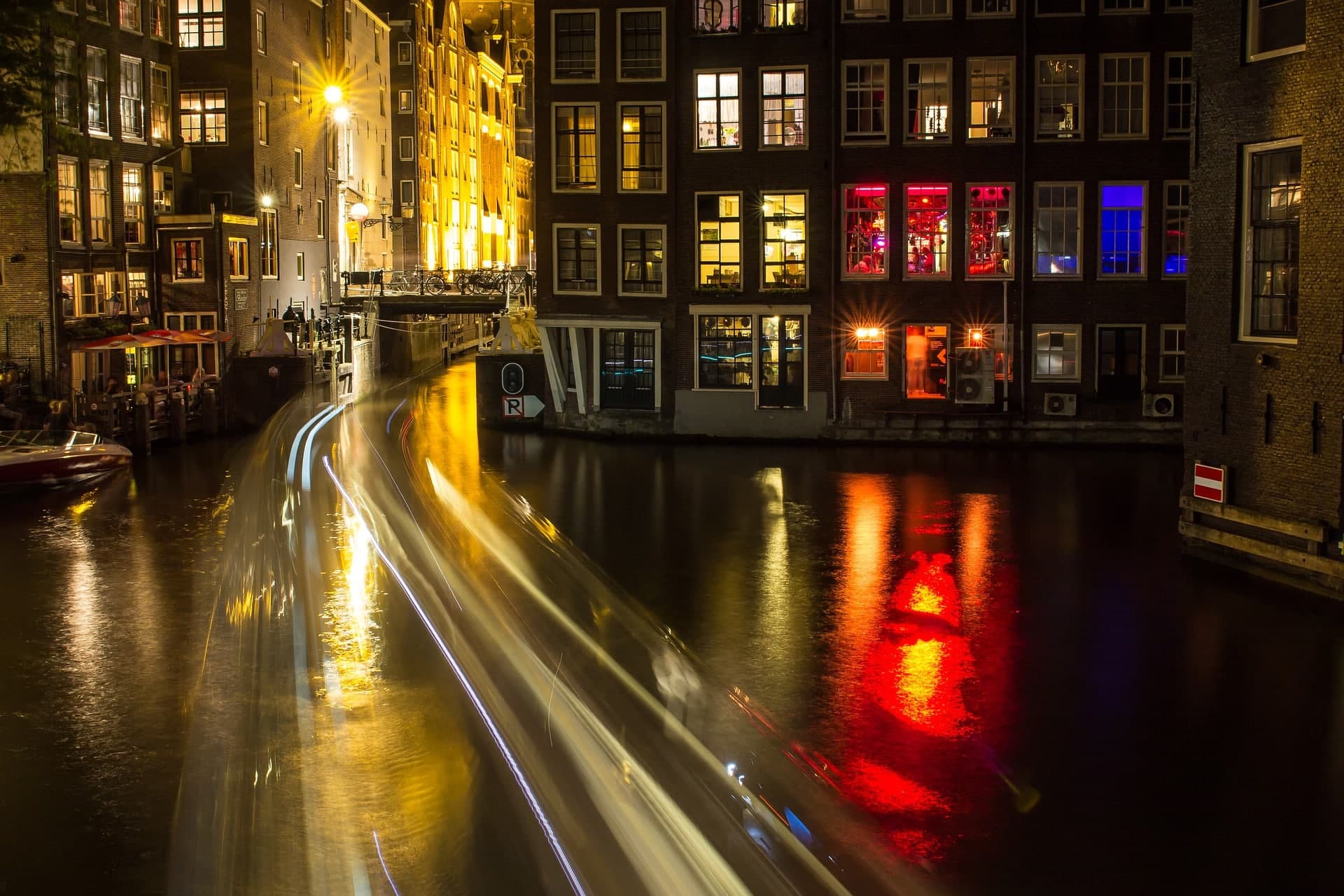
Let's zoom out from the neighborhood to the entire city. Another issue plays out there: not just safety, but also space.
In Amsterdam, mobility demand is growing rapidly. According to the report “Amsterdam Maakt Ruimte” (Amsterdam Makes Space), public transport use will increase by 40%, bicycle traffic by 39%, and car traffic by 28% toward 2034. Because building more infrastructure is hardly possible anymore in the overcrowded city, the conclusion is: Amsterdam must handle what it has more smartly.
A consortium of TU Delft, AMS Institute, and Technolution is therefore investigating a new system: mobility credits.

Mobility as a shared value
The idea is as simple as it is radical: give people a budget for travel. Every trip ‘costs’ a portion of that budget, depending on the impact. Cycling is cheap, driving a car costs more. This gives people the space to coordinate together on who chooses which trip.
The concept is not new: it has existed since 1997. Yet it has never been put into practice. There were experiments, however. For example, participants in a game were presented with scenarios: it's raining and you're going out to dinner with friends, which travel option do you choose? Each option costs credit, and sometimes participants could also buy or sell this credit. And that's where something striking happened. As soon as people could see each other's choices, they began to act for their own gain. Simply because the system made that behavior possible.
It was a confronting but educational discovery: cooperation requires rules of play.
From game to reality
The next step, the metaCCAZE project, brings this idea into practice. Not everyone receives the same amount of credit anymore, but an amount that fits his or her situation. This depends on distance, transport alternatives, and household composition. Participants track their balance via a digital platform.
And with this, a new engagement space is created: a digital place where people coordinate their travel choices among themselves via fixed rules of play. People do not just follow their own travel behavior, but primarily gain insight into the collective picture. For example: what is the ceiling that we as a group of people (e.g., working at the same organization) can strive for to cause fewer emissions, less space usage, or fewer accidents?
The emphasis there is not on restrictions, but on awareness. “No one wants to be restricted in their mobility, and that is understandable,” says Daniël Scheeroren, researcher at AMS Institute. “That is why we have chosen to make the ‘ceiling’ a target value instead of a restriction. Hopefully, awareness of that target value will already account for a large part of the change.”


Learning from what already works
The SafetySafe and mobility credits seem completely different. One is visible on the street, the other takes place in data and apps. Yet they touch upon the same core: organizing interaction. Both initiatives encourage people to coordinate behavior, see each other's perspective, and work together within rules of play that they understand and help shape themselves.
That is the essence of an engagement space. A place where cooperation arises, where ‘accommodating the other’ pays off, and where people learn to deal with scarcity without it feeling like a loss. Whatever form it takes, it always starts with the question: “how do we make mobility something we manage together again, instead of every man for himself?”
Conclusion
From the village street to the crowded city, we see an increasingly clear necessity everywhere: we must handle space differently. But we don't want people to change because they “have to.” We want it to feel meaningful to do something different. We want them to understand why it is necessary, to feel that it is fair, and to see what it yields for themselves and others.
Connekt sees this as a promising direction. Examples like the SafetySafe and mobility credits provide the first outlines of how this new perspective can work in mobility. Behavioral change then happens not out of a sense of duty, but because the system makes it logical. Engagement spaces show how we can organize that.
Would you like to share your thoughts on this? Please contact me at sybe.andringa@connekt.nl