
Secretary-General of IenW Jan Hendrik Dronkers: "To bring public and private sectors together, you need Connekt"
Connekt connects governments, knowledge institutions, and the business community. Jan Hendrik Dronkers, Secretary-General of the Ministry of Infrastructure and Water Management, on public-private partnership and 25 years of Connekt.
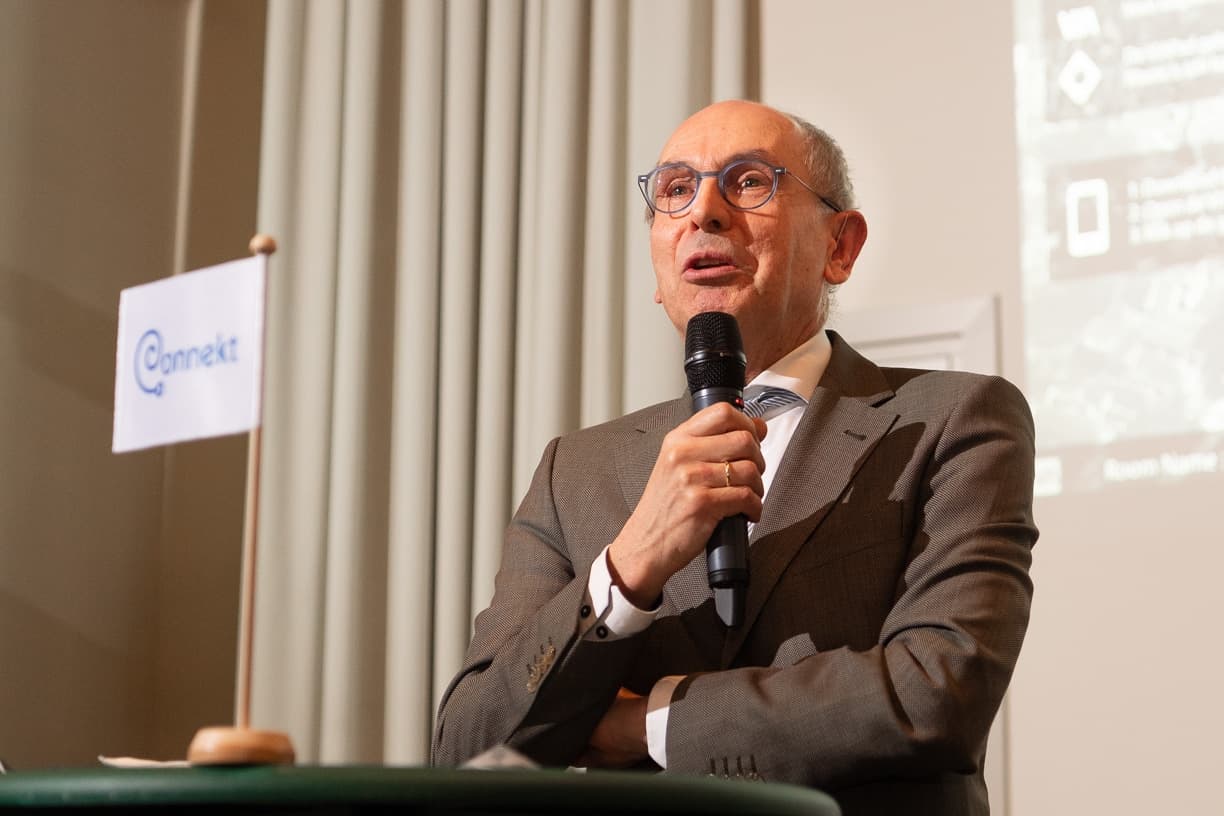
Dronkers describes Connekt with three words: useful, inspiring, and effective. He has seen the role of Connekt change over the past 25 years. When Connekt started in 2000, we were in a time when the relationship between government and the business community was considered important but was not yet well developed, Dronkers explains. “We felt that as a government we had to move more toward the market, that we had to do more public-privately.” Connekt was intended to fulfill a role in that. This actually came about with some difficulty. “From birth to the end of puberty took about seven years,” says Dronkers. “In 2007, the tables for 'Paying Differently for Mobility' were established. That was a huge social issue, and that's when it actually started to take off.”
Connekt became famous for its study trips, according to Dronkers. “That was a very good formula. You brought people together, outside their own comfort zone, went to a foreign place to see how others did it, in order to learn. There was no agenda with which you had to negotiate things. That provided an enormous amount of connection in the network, an enormous amount of bonding.” Dronkers himself went on study trips to Scotland and Hong Kong. “I still have good memories of them.” During the study trip to Scotland, the focus was on using telephone data for traffic jams. “Connekt was also ahead of its time there. By looking even then at how you can influence or improve mobility with the help of other data.”
Later, in addition to being a network organization, Connekt also became an implementing organization, for example for Lean & Green. This was initially made possible by the ministry. When the subsidy stopped, the business community took it over themselves. “I think that is a very nice example of something that was publicly jump-started, because of the public interest, and was eventually taken over and financed by the business community.” Meanwhile, Lean & Green has been adopted by ten other countries.
Facilitating public-private partnership
According to Dronkers, government and market parties have the idea that they are very different from each other. That is why it is important to organize the connection. “When you organize that connection, you notice that the differences are often exaggerated.” He gives an example. “The public sector goes for public interests and thinks that the private sector only goes for making a profit. But that is not the case. They also go for public interests, but making a profit comes first. For the government, efficiency is not the primary focus, but it is also an important point. The emphasis lies in a different place for public and private, but there is more connection than you think.”
To bring the public and private sectors together, you need help. “An organization like Connekt helps to establish that connection because they do not have a biased opinion. Connekt does not have to be public or private, but can simply form the connection. It is a catalyst in the process and has a neutral role. You simply need that to bring worlds that think they are very different into contact with each other, because that does not happen automatically.”
As an example of a successful project involving public-private partnership, Dronkers mentions the November 5th group organized by Connekt regarding 'Better Informed on the Road'. What information do you give to road users? There were all kinds of emerging parties collecting data, and the government was also collecting data. “It was incredibly inspiring to see how we could ensure we didn't fight each other, but complemented each other and discovered how we could make it better for the consumer/citizen.”
Common enemy connects
Public and private always need each other. But the awareness of the necessity of public-private partnership varies from time to time, says Dronkers. “At the moment when the challenges for the country as a whole increase—and we are currently in such a time—the realization that you need each other also increases. A common enemy always connects.”
Dronkers mentions three challenges that are important now. First of all, digitalization. “A lot of new technology is coming at us. At the same time, this digitalization also brings enormous vulnerability. Especially in relation to the geopolitical circumstances in which we now find ourselves. Where we as Europe must do more ourselves and must not be naive, must not become a plaything for others. We have been rudely awakened from the whole idea of 'the world is a global village' and trade spreading globally—a thought that really predominated a decade ago. You see a multipolar world emerging, with a few large power blocks, to which Europe will have to relate. That has enormous consequences for how we handle digitalization, also for the logistics sector.” The second challenge Dronkers mentions is making the sector more sustainable, and thirdly, giving a voice to logistics. “How do you ensure that we socially experience that logistics is very important and that it must be well organized? Connekt really fulfills a role in that as well.”
Neutral platform remains necessary
To keep public-private partnership vital, a neutral platform and a connector like Connekt remain necessary. In this, new forms will constantly have to be sought. The repertoire so far consists of organizing meetings, tables, and study trips, and a piece of implementation. Dronkers: “New repertoire will have to be added to that, because every era demands its own things.” He continues: “Connekt's clubhouse will have to be renovated, will perhaps also have to be a bit virtual, but also physical. If the organization manages to renew itself, they will add another 25 years to it. If they stand still, it will stop at some point.”
During the symposium concluding Connekt's 25th anniversary, Jan Hendrik Dronkers addressed all those present in the video message below.
Would you like to know more about Connekt's 25th anniversary? Then visit our special theme page 25 years of Connekt!