
Towards greater impact with behavior
Why do measures to influence traveler behavior work one time and hardly at all the next? And how do we ensure that knowledge about this reaches the right people? A joint project by IenW and Connekt focused on developing a structural knowledge base that helps answer exactly these questions. In this article, you can read about the proposed approach and the most important insights to date.
Behavioral measures: a growing role, fragmented knowledge
Governments, regional implementation organizations, knowledge institutions, and consultancy firms are increasingly using measures to influence traveler behavior and achieve policy objectives. Due to the limited feasibility of (new) infrastructure, behavioral measures form a cost-efficient instrument to contribute to policy goals in an adaptive and solution-oriented manner.
This also increases the need for systematic insight into the effectiveness of these measures and the circumstances under which they work.
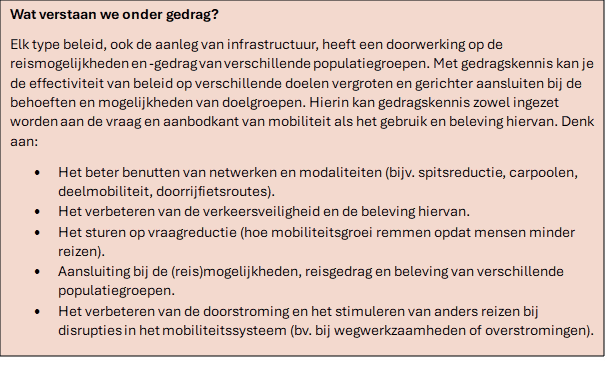

However, the way in which knowledge about behavioral measures is currently built up and utilized still falls short. In practice, measures are often developed and evaluated on a project basis, with varying goals, methods, and indicators. This makes it difficult to compare results, understand the causes of success or failure, and apply lessons in other contexts. Different parties run the risk of reinventing the wheel independently of each other, resulting in the loss of much knowledge and resources.
Despite various initiatives to bundle existing knowledge on the use and operation of behavioral measures, a joint and structured knowledge base is still lacking. As a result, it often remains unclear which measures are effective in which context. The consequence is that similar measures are regularly redeveloped, with varying quality and limited comparability of results.
The approach: a data-driven knowledge base for behavioral measures
A structural, data-driven knowledge base enables parties to build and share knowledge. This creates better insight into what works, under which circumstances, and with which data and indicators this is supported.
To determine what such a knowledge base should look like, IenW and Connekt organized a short trajectory with three meetings. Behavioral experts from behavioral agencies, municipalities, provinces, regional implementation organizations, knowledge institutions, and DGMo participated in these.
Based on the input gathered, IenW proposed to develop a 'menu', based on existing knowledge about behavior. This refers to a structured overview of behavioral measures appropriate for a specific task, situation, and context, including information on their effectiveness and application conditions. The aim of this menu is to structure existing knowledge, establish uniform principles through a basic set of indicators, and identify knowledge gaps.
Central to this is the data-driven behavioral approach developed by IenW. In this approach, behavioral measures are developed, monitored, and evaluated in a systematic way based on fixed indicators. This enables fact-based learning: insight into why certain measures work and how successful measures can be scaled up and applied in other situations more quickly.
Together with a broad network of behavioral experts, IenW and Connekt want to elaborate various cases regarding behavior within mobility. Each case is elaborated by filling in three information layers:
- Spatial design and use of the network
- Travelers
- Policy, trends, and developments.
By recording this information in a uniform way, the basis for the joint menu is created.
The first work session: validating the approach
The proposed approach was presented and further refined during two work sessions. During the first work session on February 10, the central question was what is needed to arrive at a joint knowledge agenda.
The discussion focused on three main questions:
- Which area characteristics are relevant in relation to changes in travel behavior?
- How do these characteristics lead to behavioral change?
- Which conditions are essential for the success of behavioral measures?
In addition, participants were asked where the greatest need for knowledge still lies. The following points emerged:
Focus on target groups
Participants emphasize the importance of insight into the willingness to change and the impact per target group. They have a need for structured knowledge building in this area.
Effect on policy goals
The effect of various measures affecting behavior on policy goals is also mentioned as an important component of the knowledge base.
Utilize existing knowledge
Participants indicate that a lot of knowledge regarding behavioral change is already available. According to them, the priority lies in bundling and making this knowledge accessible, to prevent time being spent on exploratory research again.
Work case-oriented
It is proposed to start with concrete themes in follow-up sessions, such as the theme of peak spreading and avoidance, and to build up knowledge from there in a case-oriented manner.
During the first work session, the proposal was made to develop a menu as a structure for organizing existing and new knowledge.
From exploration to focus: elaboration of the menu and preferred themes
In the second work session on March 3, IenW presented an initial elaboration of the menu. This addressed the various information layers needed to interpret the operation and effectiveness of behavioral measures.
A demonstration of a dummy tool provided insight into how a structural knowledge base on behavior can function in practice. The tool showed how, based on a few characteristics of the context and situation, appropriate measures, best practices, and advice can be quickly retrieved, including substantiation. This supports behavioral experts in developing solutions faster and refining key figures on the effects of measures.
In the interactive part of the session, participants introduced use cases that they consider important for the follow-up. These were then prioritized in a plenary session.
The most important themes are:
- Spreading traffic throughout the day, including solution directions such as price differentiation and influencing demand (work, education, childcare, etc.)
- Structural behavioral change through roadworks
- Stimulating shared mobility
- Stimulating active mobility (walking, cycling) and public transport, with a focus on commuters and students in small towns and new residential areas;
- Stimulating safe traffic behavior, with a focus on alcohol and drug use and social safety at and around train stations
The follow-up: from exploration to concrete agreements
During the first work session, it was proposed to work in a case-oriented manner. By initially focusing knowledge building on a number of concrete policy goals with associated target behaviors and target groups, the process remains practical and applicable.
In the coming period, IenW, the DMI ecosystem, and Connekt will work towards a concrete follow-up. This starts with three working groups in which three cases will be further elaborated. Other themes will explicitly remain in view and serve as input for a possible next phase.
The goal of these working groups is to collect and structure existing knowledge and practical experiences together with behavioral experts. Therefore, no new research will be started initially. Attention to quality and context is central: making clear what works, under what circumstances, and with what degree of substantiation.
In this way, we are working towards a knowledge base on behavioral knowledge and a supporting tool, with which appropriate behavioral measures can be found quickly and with substantiation.
Would you like to participate in this project? Then register now for the kick-off meeting on Tuesday, June 16! Do you have other questions or suggestions? Please contact Sybe Andringa (Connekt) or Joyce van Leeuwen (IenW).