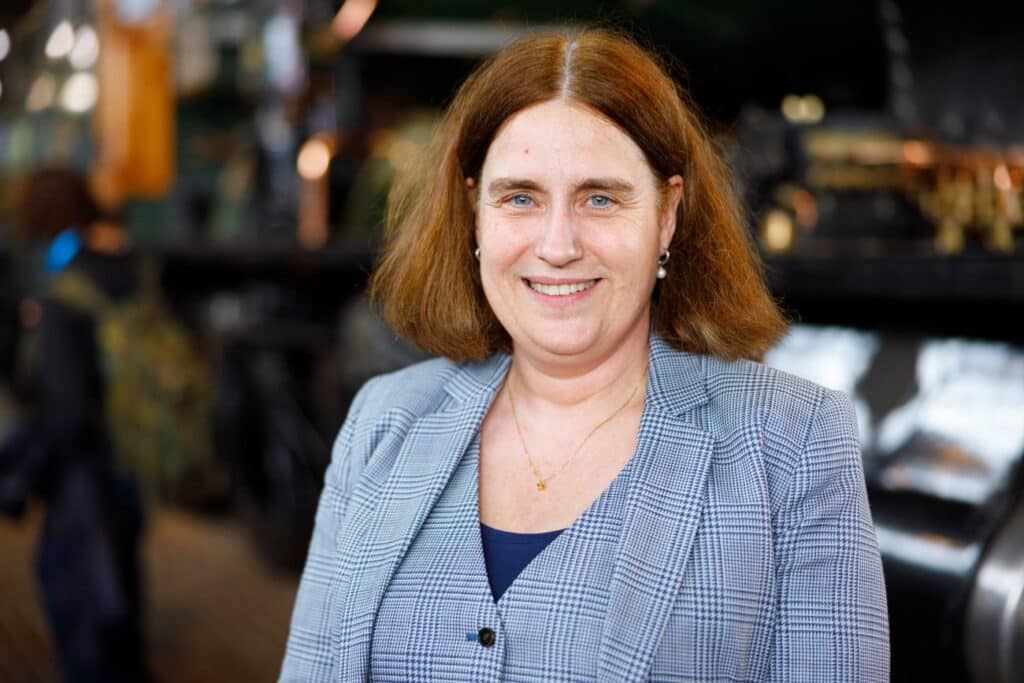
"Without technology, we are no longer going to make it happen"
The logistics sector faces enormous challenges: geopolitical uncertainties, personnel shortages, stricter sustainability requirements, and increasingly complex chains. Finding solutions to all these issues simultaneously seems almost impossible. Yet Astrid Buijssen, Director of Traffic Management at ProRail and Chair of the Chains Steering Committee of the Top Sector Logistics, sees a clear way forward: technology. Without digital transformation, the sector simply cannot progress further. In this interview, Buijssen shares her vision on the role of technology, the connecting power of Connekt, and the steps needed to prepare the sector for the future.
It is clear that the logistics sector is undergoing a digital transformation. Astrid Buijssen, Director of Traffic Management at ProRail, is involved in this transformation through her work. Not only within the companies where she works or has worked, but also within the Top Sector Logistics. "I believe that without technology, we are no longer going to make it happen."

Connekt is part of the program office of the Top Sector Logistics. Astrid Buijssen has been involved with the Top Sector for years and knows Connekt well. The first word she mentions to describe Connekt is 'connect', which is of course what the name indicates. In addition, she finds the words 'driven' and 'professionals' to be a good fit for Connekt. She explains: "Very passionate people work at Connekt. When you drive innovation, you sometimes have to persevere based on your own inherent motivations. You have to show people something they might not be fully convinced of yet. I believe that this drive is the reason why many people dare to take a step forward." Regarding the word 'professionals', Buijssen says: "In terms of content, they have such a good understanding at Connekt of what is going on, what is possible, and what is at play. They have a very diverse background with expertise and capabilities, and that all comes together in the organization."
At Connekt, they understand the logistics sector incredibly well, according to Buijssen. "They manage to utilize all those different parties in that enormously diverse field. And to help all those parties take a step further. That is of great value to the sector. Bringing together technology, practice, and knowledge in this world is something Connekt does like no other."
Challenges within chains
Buijssen is Chair of the Chains Steering Committee of the Top Sector Logistics. Several developments are playing out in the field of collaboration within logistics chains. First of all, demonstrability within the chain is becoming increasingly important. In addition, supply chains must be able to respond more quickly to disruptions caused by geopolitical developments, climate issues, etc. They also have to deal with labor market shortages, the fact that the duration of employment at companies is changing, shifting profiles, and thus the experience level of employees. And all these problems are occurring simultaneously within organizations. "It is almost impossible to imagine how you can solve these increasingly complex problems without the help of technology."
Buijssen focuses on digital transformation from the business side, not the IT side. "I might not understand the technology at all, but I do believe that without technology, we are no longer going to make it happen. To take steps forward and solve problems within the operational process, technology has increasingly become a tool in recent years." In her role, Buijssen looks at how organizations and employees can become enthusiastic about technology, start sharing their knowledge, and ultimately truly get to work with the technology.
Digitization then, now, and later
In the past, information within a chain was primarily transferred physically or by telephone. Humans were, as it were, the postmen delivering the information. Gradually, this shifted by sending letters digitally, for example via email. "Now we are moving towards systems that will do that for you with each other," says Buijssen. "The role of humans has changed. We no longer handle the transfer ourselves; a machine is going to do that for us. How do you then ensure that the systems performing this for you can do so smartly, responsibly, reliably, and safely? Technologically, this is probably already possible, but having the courage as a person or organization to implement it smartly is where we still have many steps to take."
Buijssen expects that in the future, we will be largely supported by smart systems to share information and ensure logistics processes align well. "And that we as users—whether they are companies shipping goods, carriers, or inspectors—can use technology much more purposefully and let ourselves be supported by data and systems."
Top Sector Logistics
Steven envisions the future of BDI in the same way as digital money transfers work today. "When we transfer money to each other, we use the bank's Swift system. That is the framework for transferring money. As a user, you don't need to know anything else about that framework. For BDI, this means that as a regular transporter, you don't need to know that a wonderful system called BDI exists, but you do know for sure that if you share data with another organization, it happens correctly and is properly handled by your IT provider. And that IT provider ensures they are properly connected to that framework. I expect it to become a standard: it's just there, we assume it's there and that it works, and you can trust that it is safe."
Would you like to know more about Connekt's 25th anniversary?
Then visit our special theme page 25 years of Connekt!