"We must have that public-private dialogue with one another"

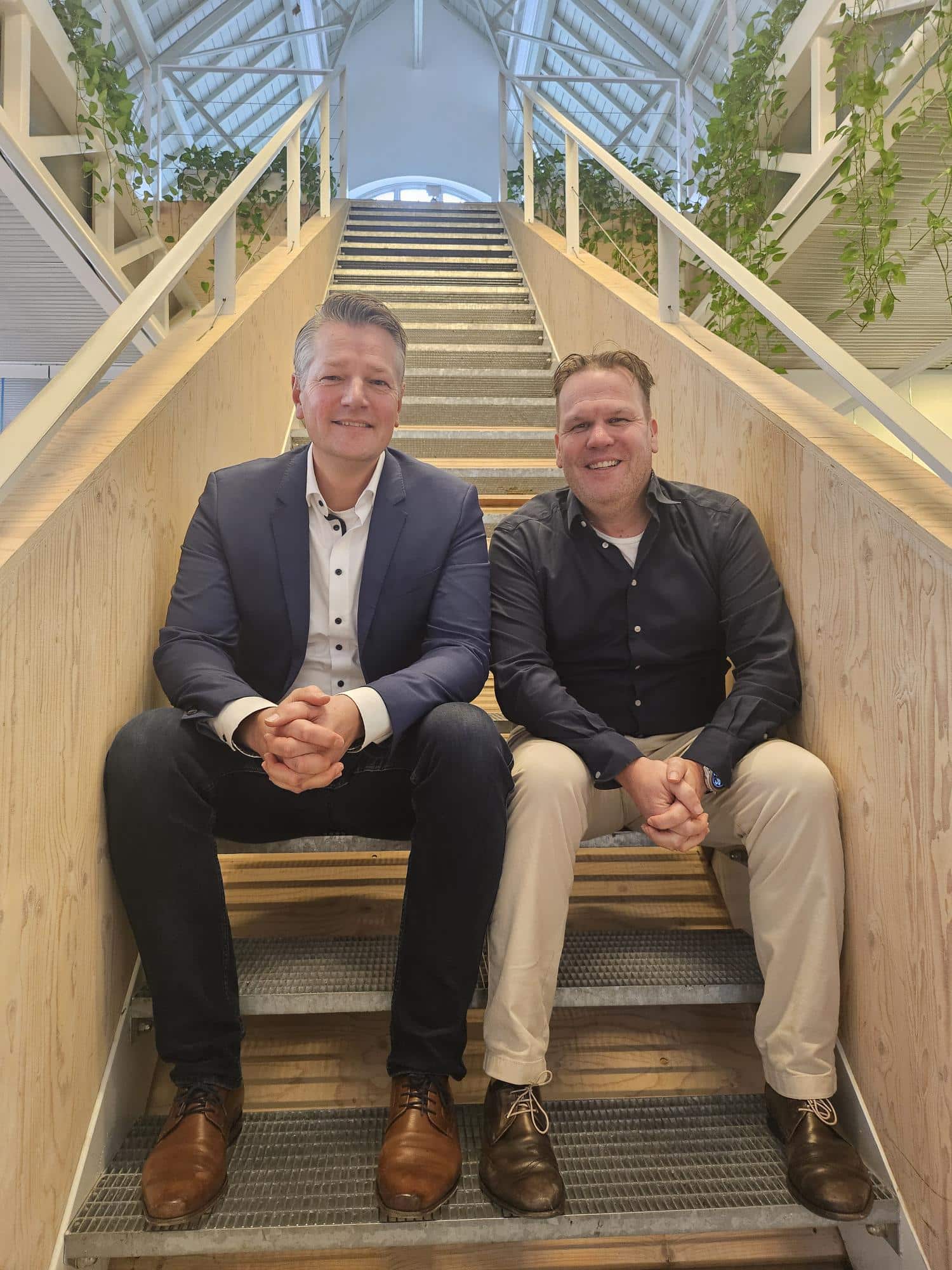
Danny Vroemen of Vialis and Herman Bosker of Capgemini share their experiences on the importance of public-private partnership and the joint commitment to the mobility of the future. Together, they work on solutions that make mobility in the Netherlands more sustainable and improve accessibility.

When you ask Danny Vroemen to describe Connekt in three words, he says: open, living room, connecting. “I find the connecting side very important at Connekt. We often meet at the coffee bar, at the bottom of the stairs at Connekt. That is where the real conversation takes place. It gives a bit of a living room feel.” Vroemen is Head of Product Strategy & Sales at Vialis and a member of Connekt's Advisory Board. He has worked at Vialis for two years but has been involved with Connekt for much longer. About 22 years, he says. “My first career steps were at Vermeer Infra, now Dura Vermeer, a company that was involved in the initial founding of Connekt.”
Capgemini is also among the co-founders of Connekt. Herman Bosker, Vice President and owner of the Mobility value chain and, like Vroemen, a member of the Advisory Board, has been involved with Connekt himself for about five years, the last two of which have been much more active. He describes Connekt in three words: public-private, network, collaboration.
Using an example from the past, Vroemen outlines the importance of that public-private partnership. “One of the first projects I did at Connekt was the introduction of cell broadcasting in the Netherlands. This was a joint project between Connekt, the Ministry of Transport, Public Works and Water Management, the Ministry of the Interior, CMG, and KPN, where we looked at how to develop cell broadcasting as a government service.” This was interesting in the context of road pricing, which was being worked on at the time. But the pilot was conducted under the banner of public emergency alerts to avoid political discussions. “I believe that same technology is still used for the monthly alerts on your phone.” Because this was a public-private partnership, made possible by Connekt, the private parties knew what they could do with the technology and where the market was headed. At the same time, it was clear to the public parties what they still needed to organize to actually make it happen. According to Vroemen, that is exactly the dialogue that is still being conducted within Connekt today.
Mobility and Accessibility Implementation Agenda
For the coming period, the Mobility and Accessibility Implementation Agenda is the most important topic that both parties within Connekt will be working on. Bosker explains that Kees van der Burg, Director-General of Mobility at the Ministry of Infrastructure and Water Management, spoke during an information session about the Ministry's Mobility Vision. This vision is about keeping the Netherlands accessible for everyone heading toward 2050. In this vision, mobility is made more sustainable, something is done about congestion, and urban densification is supported. The Ministry believes that in order to solve the accessibility challenge, the 'mobility lever' was pulled too often. We must look not only at the supply of mobility but also at managing mobility demand. With the statement: “We know what to do, but we don't know how. Help us make our vision concrete!”
One of the insights is that while policy is made for mobility, there is no implementation organization for mobility. In other words: there is a gap between policy and what is done in practice. Vroemen: “You can see that the gap between policy and implementation has only widened over the past ten years. We must achieve that public-private dialogue with each other to move forward as a country.”
Bosker: “We have taken up the gauntlet by drafting a response to the Mobility Vision as the Connekt network. It is important that we did not start from a traditional client-supplier relationship, but are sitting at the table as equals and organizing a process together.” In this way, a number of components from the Mobility Vision can actually be realized.
Within the Connekt network, the idea arose to aspire to a kind of 'Top Sector Mobility,' analogous to the Top Sector Logistics. The initiative for the Mobility and Accessibility Implementation Agenda originated from that idea. With unanimous support for this approach, the next step is to determine a joint vision with the parties involved on the partnership model on the one hand and the content on the other. What exactly are we talking about? It is important to reflect on that first. “From there, we can look at what steps are needed to arrive at a supported implementation agenda,” says Vroemen.
Increasing effectiveness
Bosker: “I know Connekt as an organization that combines the substance of an issue with facilitation and a network. I believe there is also a lot of expertise within parties in the market.” Bosker believes that Connekt should facilitate an ecosystem more or bring it together where necessary. And then let members from the network actively collaborate on results. “Connekt is very good at that, and it increases the effectiveness of the whole.”
He advises breaking the large topic of mobility into smaller pieces and then looking for collaboration around those themes that can be truly effective. For each theme, look for parties with a common interest before you start working on the content. “I think it will help enormously not to lump everything together.”
Bosker and Vroemen advise Connekt to continue in this way, while maintaining focus on public-private partnership and the relevant social themes.
Would you like to know more about Connekt's 25th anniversary?
Then visit our special theme page 25 years of Connekt!